REDUCING DEPENDENCY. BUILDING RESILIENCE. SECURING SOVEREIGN FUTURES.
C3SA brings Canadian and European technology together with architecture, integration, assurance and operational expertise to help organizations retain meaningful control over critical digital capabilities.

SOVEREIGN SOLUTIONS.
SECURE TOMORROW.
Sovereignty is not simply where technology is headquartered or where data resides. C3SA focuses on control: jurisdiction, privacy, identity, cryptographic authority, operational resilience, supply-chain dependency and the ability to operate when conditions change.
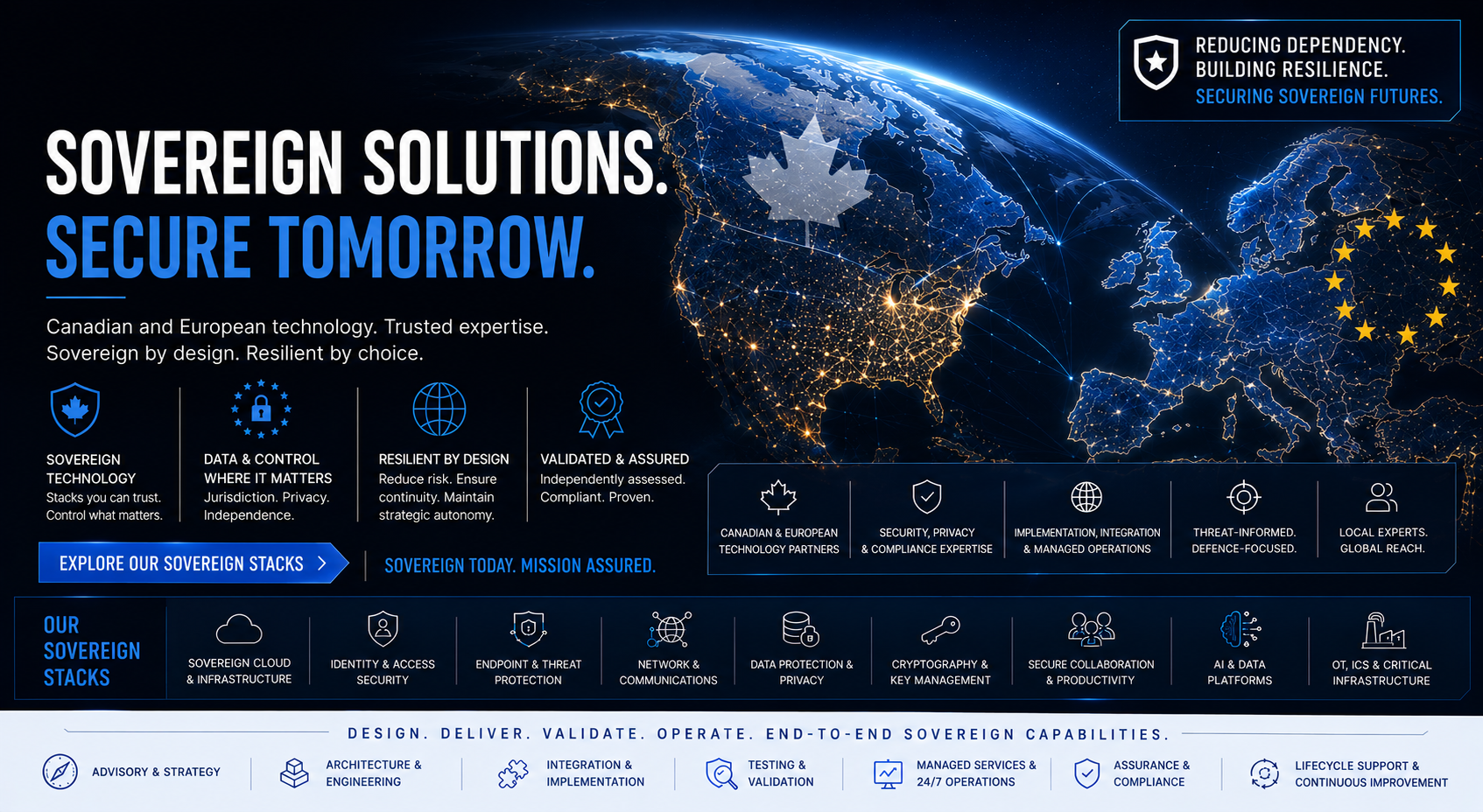
CONTROL THE LAYERS THAT MATTER.
DESIGN. DELIVER. VALIDATE. OPERATE.
PROCUREMENT THAT ACCOUNTS FOR CONTROL.
Procurement must account for control, jurisdiction and resilience as well as features. C3SA helps buyers define sovereignty requirements, evaluate candidate solutions and suppliers against them, and integrate the selected technologies into the existing stack.
Every claim is checked per product and component: who owns the supplier, where the product is built and supported, where data is processed and who holds the keys. “Canadian-made” or “European” is verified, not assumed.
Does sovereign mean replacing everything?
No. The objective is not isolation but deliberate choice. Most organizations start with the layers that control everything else, such as identity and key management, and add sovereign options where the risk justifies them.
How do you compare sovereign and mainstream options?
Against a requirements matrix covering jurisdiction, operational access, support, portability and features, with the trade-offs documented for each option.
Can sovereign technology work with our existing platforms?
Yes. Integration with existing identity, cloud, security operations and data platforms is part of every C3SA deployment.
ADVICE. IMPLEMENTATION. PROOF.
Procurement must account for control, jurisdiction and resilience as well as features.
C3SA helps buyers define sovereignty requirements, evaluate candidate solutions and suppliers, and integrate the selected technologies into the existing stack.
A requirements matrix, supplier comparisons, architecture and documented trade-offs.
The objective is not isolation. It is the ability to make deliberate choices about technology, data, identity, cryptography, suppliers and operations—and to maintain resilience when geopolitical, commercial or technical conditions change.
PUT YOUR DEPENDENCIES UNDER PRESSURE.
Pair a cross-domain Sovereignty & Resilience Workshop with a hands-on Digital Sovereignty Hackathon - from strategic dependency mapping to technical validation.